

01
Receive the business message
The right Inbox receives a message with its source, identity, schema, and operating context.
The runtime loop
The runtime does not hand raw company data to an agent and hope for the right outcome. It prepares a governed task, resolves authority, and captures the result as the next business message.
The right Inbox receives a message with its source, identity, schema, and operating context.
Deterministic policy decides which context, tools, Companions, approvals, and actions are permitted.
A person, system, agent, or Companion investigates, proposes, prepares, or performs the allowed task.
The result becomes a traceable business message that can update state or trigger the next explicit rule.
One runtime, three planes
Models, tools, and providers will keep changing. The message contract and business conditions should not have to change with them.
Schemas, identities, purposes, permissions, rules, approvals, retention, and result contracts remain explicit and versioned.
AI cannot silently redefine policy.
Approved AI Companions can be selected by task, data sensitivity, region, output requirement, capacity, or cost policy.
The business contract stays provider-independent.
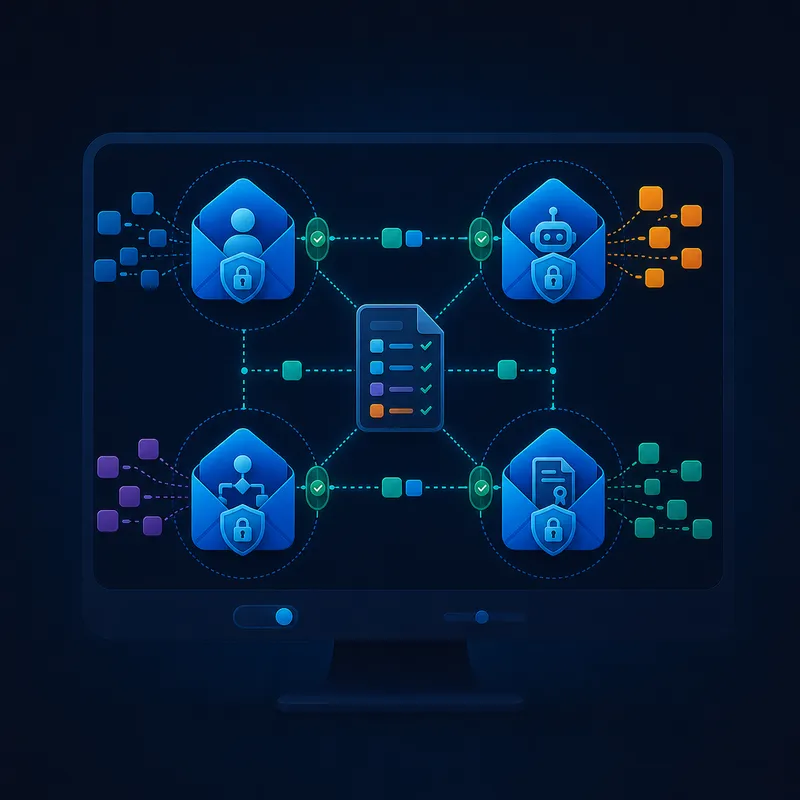
Independent Inboxes exchange only the messages and results their own policies permit. No single Inbox needs every source record.
A dossier can exist without one central data lake.
Federation, not centralisation
Customer, order, payment, consent, and case information can remain inside separate operating and security boundaries. Each Inbox contributes only the reference, message, or result the current operation is permitted to use.
Participants, not owners
The runtime coordinates who or what may participate. None of them receives broader authority merely because it can produce an answer or perform an action.
Use governed context and return proposals or results through a defined contract.
Make approved AI, payment, identity, and future communication or delivery providers available to authorised Inboxes under company-defined conditions, with state and evidence returned.
Expose approved APIs, tools, and MCP capabilities without bypassing the receiving Inbox.
Review exceptions, apply judgment, approve material actions, and remain part of the same evidence trail.
Controlled configuration
Runtime configuration follows a predictable path. Teams can inspect validity and intended differences, simulate the change, and only then apply it.
Dry-run makes intended runtime behaviour reviewable before live messages are affected.
Deployment control
The managed SaaS runtime is currently configured on DigitalOcean. Shared platform and infrastructure controls support the Inboxes that run there.
Other regional, data-centre, or customer-controlled arrangements are architecture and service-scope decisions. They are evaluated against residency, network, identity, availability, and operational requirements.
It solves a different layer. An agent framework helps define agent behaviour. DataInbox Agent Runtime governs the business messages, context, permissions, capabilities, approvals, results, and evidence around that work.
No. AI may interpret input or propose work, but deterministic configuration and rules decide which context may be shared and which action may proceed. Human approval can remain mandatory where judgment is required.
Yes. They participate through defined message and capability contracts. The Inbox determines which context may leave, which capability may be invoked, and what result is accepted back.
No. Each Inbox remains a separate policy boundary. A dossier can be assembled from permitted references, messages, and results while source data remains with the Inbox that owns its operating context.
Configuration can be validated, compared, dry-run, and then applied. This makes the intended change visible before it affects live message handling.
The managed SaaS runtime is currently configured on DigitalOcean. Other regional, data-centre, or customer-controlled arrangements depend on the agreed architecture and service scope.
Start with one business message, one operating context, and the conditions that must remain authoritative.