Architecture Deep Dive

    AI Agent Governance
    Infrastructure

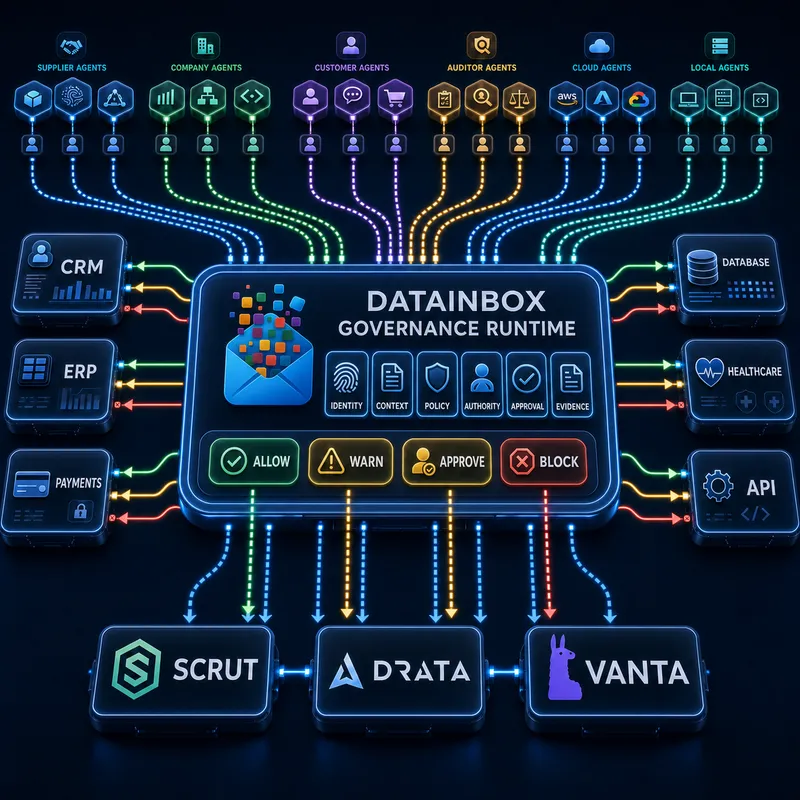
    AI agent governance is the operational layer that decides what autonomous agents can do, which data they may access, and how every action is validated and audited. DataInbox delivers it as programmable infrastructure: structured proposals, deterministic policy enforcement, expert-in-the-loop review, and immutable compliance artifacts.

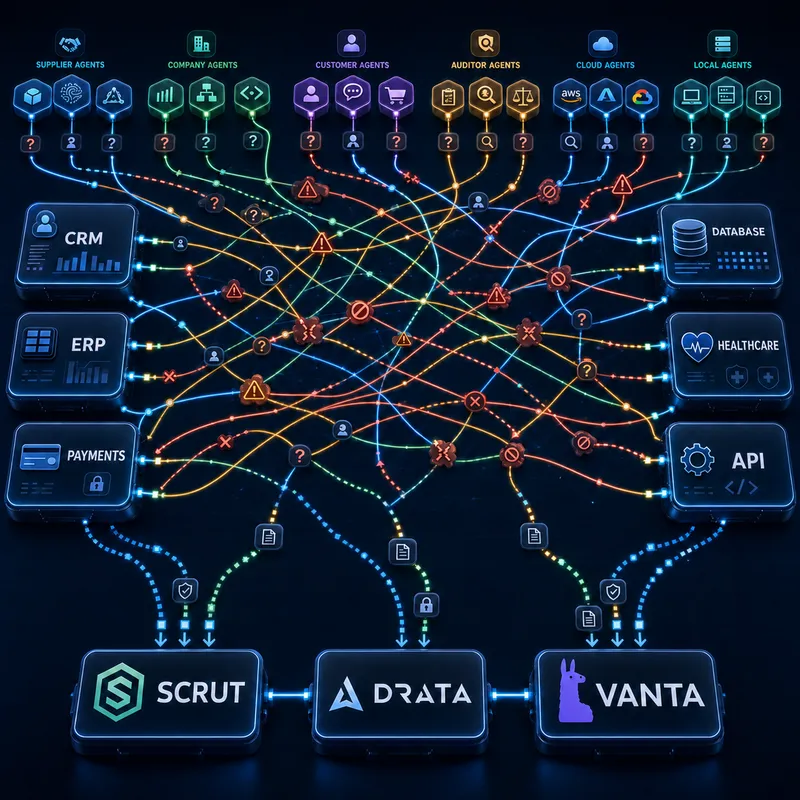
    The Structural Risk No Guardrail Solves

    The risk isn't data access. It's autonomous interpretation and execution without a governed interaction layer.

    Cross-context data combination

    Agents silently merge data across systems, creating unintended profiles without consent.

    Persistent memory accumulation

    Goal-driven autonomy lets agents accumulate sensitive insights beyond their original scope.

    Probabilistic guardrails fail

    Model-level guardrails are best-effort, not contractual. They cannot enforce deterministic enterprise rules.

    Blurred accountability

    When actions span multiple systems, accountability dissolves. Regulators will not accept 'the AI decided.'

    Purpose limitation erodes

    Data minimization and purpose limitation become structurally impossible in open agent loops.

    Leakage through reasoning

    Privacy exposure happens through inference, not export - invisible to traditional audit tools.

    From Proposal to Governed Outcome

    Every agent interaction follows a deterministic, traceable path. No shortcuts. No ungoverned execution.

    1. Agent Submits Proposal

    Structured intent - what the agent wants to do, which data it needs, and the expected outcome.

    2. Inbox Validates

    Schema validation, policy checks, purpose limitation enforcement, and data minimization rules applied.

    3. Expert Reviews Exceptions

    Edge cases and policy exceptions routed to domain experts. Standard proposals auto-approved.

    4. Decision Recorded

    Approval, rejection, or adjustment becomes an immutable compliance artifact with full context.

    5. Controlled Execution

    Only approved proposals reach enterprise systems. Every action traceable to its original proposal.

    6. Outcome Validated

    Results captured as structured compliance objects. Closed-loop governance from proposal to outcome.

    Six Governing Pillars

    The architectural principles that make Agent Inbox a governance infrastructure - not just another agent API.

    Structured Intent

    Agents Propose. DataInbox Decides.

    Instead of Agent → Database, the architecture is: Agent → Agent Inbox → Validation → Controlled Execution. Agents request structured outcomes - purpose-limited, schema-validated, and logged before anything reaches execution.

    Deterministic Governance

    Governance Becomes Architectural

    Deterministic schema validation, policy enforcement before execution, role-based data exposure, and full audit trail of every proposal. Governance is the architecture - not bolted on as an afterthought.

    Compliance Artifacts

    Every Output Is a Governed Artifact

    Every agent result becomes a structured compliance object: what was requested, data accessed, rules applied, constraints enforced, and whether execution was approved. This is far beyond a log.

    Privacy by Design

    Privacy Intrusion Prevented Architecturally

    Data minimization at message level. Context-scoped exposure. Structured data contracts per agent. No direct database visibility. Rejection of requests violating purpose limitation.

    Controlled Experimentation

    Safe Agent-to-Agent Environments

    Agents negotiate in structured messages. No production system is directly modified. All proposals validated, all outcomes recorded. Only approved results reach execution.

    Runtime Traceability

    Continuous Compliance Evidence

    Real-time capture of events, decision context, AI involvement, and human oversight. Prove behavior and trace decisions end-to-end - aligned with EU AI Act and GDPR accountability requirements.

    Every Service Layer, Replaced

    The traditional enterprise AI stack requires six+ human service layers. DataInbox replaces each one with programmable software.

    Integration consultants
    Structured intake contracts

    Agent proposals are schema-validated against configurable intake contracts - no integration project required.

    Compliance review boards
    Automated policy enforcement

    Deterministic rule evaluation at the message level, with exceptions routed to domain experts automatically.

    Operational governance teams
    Expert-in-the-loop workflows

    Routing rules direct anomalies and edge cases to the right human experts - governance without headcount scaling.

    Manual audit processes
    Immutable compliance artifacts

    Every proposal, validation, decision, and outcome is captured as a traceable, verifiable record - audit-ready by default.

    Vendor management layers
    Hot-swappable AI contracts

    Switch AI providers without changing governance rules. The contract layer is provider-agnostic.

    Custom monitoring dashboards
    Built-in observability

    Real-time visibility into agent behavior, proposal volumes, approval rates, and compliance posture - out of the box.

    A New Category of Enterprise Infrastructure

    Not AI orchestration. Not a chatbot platform. Not workflow automation. DataInbox defines a new infrastructure layer.

    Agent Governance Infrastructure

    The operational layer where autonomous agents propose work within governed boundaries.

    Autonomous Enterprise Services

    Software that replaces human service layers for AI oversight, compliance, and operations.

    AI Service Infrastructure

    The contract layer between AI agents and enterprise systems - programmable, scalable, audit-ready.

    The next generation of enterprise platforms will not sell services.
    They will turn services into software.

    DataInbox is the infrastructure that turns AI operations, governance, and compliance into programmable workflows.

    DataInbox is the contract layer between AI agents and enterprise systems - where proposals become governed workflows, experts validate outcomes, and autonomous services operate without a traditional services layer.

    AI Agent Governance, Answered

    The questions teams ask before adopting governed agentic AI.

    What is AI agent governance?

    AI agent governance is the operational layer of policies, controls, and audit evidence that determines what autonomous AI agents are allowed to do, which data they can access, and how their actions are validated before reaching production systems. DataInbox provides this layer as programmable infrastructure: every agent action is a structured proposal that is schema-validated, policy-checked, and recorded as an immutable compliance artifact.

    How to govern AI agents across the organization?

    Governing AI agents across an organization requires a single contract layer between every agent and every enterprise system. With DataInbox, each agent submits structured proposals to an Agent Inbox. Deterministic rules enforce purpose limitation, data minimization, and role-based access. Exceptions route to domain experts, and every decision is captured end-to-end so governance scales without scaling headcount.

    What governance controls are needed for agentic AI?

    Agentic AI requires six controls that probabilistic guardrails cannot deliver: structured intent capture, deterministic schema validation, policy enforcement before execution, role-based data exposure, expert-in-the-loop routing for exceptions, and an immutable audit trail of every proposal and outcome. DataInbox implements all six as architecture, not as bolt-on monitoring.

    How to enable AI agents with governed data access?

    Governed data access means agents never query databases directly. They submit a structured request describing intent, scope, and purpose. DataInbox validates the request against data contracts, exposes only the minimum necessary fields, and logs the access as a compliance object. This makes GDPR purpose limitation and EU AI Act traceability enforceable at the architecture level.

    Why is observability important in governing agentic AI systems?

    Observability is the only way to prove what an autonomous agent did, why it did it, and which human approved it. Without runtime traceability, accountability dissolves the moment an action spans multiple systems. DataInbox captures every event, decision context, model involvement, and human override as structured evidence, so regulators and internal auditors get a verifiable record instead of probabilistic logs.

    Ready to replace services with software?

    Join enterprises building governed, autonomous workflows - without the consulting overhead.